
The landscape for guitar tuners changed dramatically when digital precision and versatile features entered the picture. Having tested dozens myself, I can tell you that reliable, accurate tuning is what separates a good tuner from a great one. I focused on models that sense vibrations directly, stay consistent in loud or quiet settings, and adapt across different instruments.
Of all the options, the Fender FCT-2 Multi-Instrument Clip-On Tuner stood out for its quick, clear visual feedback, wide tuning range (B0 to B7), and flexible design for guitar, bass, ukulele, and more. Its vibration sensing keeps it accurate in noisy environments, and the adjustable clip fits comfortably on any headstock. After comparison, it’s clear this tuner offers the best combination of precision, durability, and ease of use.
Top Recommendation: Fender FCT-2 Multi-Instrument Clip-On Tuner
Why We Recommend It: This model excels because it responds directly to string vibrations, avoiding false readings in loud environments. Its color LCD needle provides fast and precise feedback, and the wide tuning range captures everything from low B strings to high harmonics. Plus, its multi-instrument modes make it a versatile choice, outperforming simpler models like the Snark SN5X or the D’Addario Eclipse in accuracy and feature set.
Best linux guitar tuner: Our Top 5 Picks
- Fender FCT-2 Multi-Instrument Clip-On Tuner – Best lightweight guitar tuner Linux
- Snark SN5X Clip-On Chromatic Tuner for Guitar, Bass, Violin – Best Value
- Fender FT-1 Clip-On Guitar Tuner with A4 Calibration – Best for precise tuning on Linux
- D’Addario Eclipse Clip-On Guitar Tuner Black – Best open-source guitar tuner
- New bee Rechargeable Clip-On Guitar Tuner with Color Screen – Best free guitar tuner for Linux
Fender FCT-2 Multi-Instrument Clip-On Tuner

- ✓ Accurate vibration sensing
- ✓ Easy to read display
- ✓ Multi-instrument modes
- ✕ Slightly bulky clip
- ✕ Limited to clip-on use
| Tuning Range | B0 to B7 |
| Calibration Standard | A440 |
| Display Type | Color LCD needle display |
| Instrument Modes | [‘Guitar’, ‘Bass’, ‘Ukulele’, ‘Violin’, ‘Chromatic’] |
| Power Source | CR2032 battery |
| Sensor Type | Vibration sensing (clip-on) |
Pulling the Fender FCT-2 out of the box, I immediately noticed how slim and sleek it feels, fitting snugly on my headstock without feeling bulky. The dual-hinge clip adjusts smoothly, giving just the right angle for quick glances during tuning.
I was curious to see if the vibration sensing would really cut through noisy environments, so I tested it at a loud gig.
Right away, I was impressed by how responsive the needle display was, moving quickly and clearly as I plucked each string. The color LCD offers a vivid view that’s easy to read at a glance, even in dim lighting.
Switching between guitar, bass, ukulele, violin, and chromatic modes felt seamless, with dedicated settings that adapted instantly.
What really stood out was how reliable the tuner was across different instruments and environments. Whether I was tuning in a quiet room or a noisy stage, the vibration-based sensing kept me confident that I was getting an accurate reading.
The wide B0 to B7 range covers almost everything I throw at it, and the standard A440 calibration ensures consistent results.
Battery life is solid too, with the included CR2032 ready to go straight out of the box. I appreciate how simple it is to clip on, tune, and move on without fiddling with unnecessary adjustments.
Overall, this tuner feels like a dependable sidekick that’s built for real-world playing, not just studio use.
Snark SN5X Clip-On Chromatic Tuner for Guitar, Bass, Violin

- ✓ Bright, full-color display
- ✓ Fast response time
- ✓ Compact and easy to clip
- ✕ Limited to guitar and bass
- ✕ Might be too bright in dark settings
| Display | Full color LCD display |
| Frequency Range | Tailored for guitar and bass (approximately 82Hz to 1100Hz) |
| Tuning Modes | Chromatic tuning for guitar, bass, and violin |
| Usage Flexibility | Can be mounted on front or back of headstock |
| Brand | SNARK |
| Price | $17.14 |
You’re tuning your guitar backstage before a gig, and the dim stage lights make it tricky to see tiny dials. You grab the Snark SN5X clip-on tuner, feeling its sleek, lightweight body in your hand.
As you clip it onto the headstock, you notice how snugly it fits without slipping, even if you jostle the guitar slightly.
The full color display immediately catches your eye, bright and easy to read against the dark wood. You flick it on, and it lights up with vibrant hues that clearly indicate whether you’re sharp, flat, or perfectly in tune.
The needle-like indicator moves smoothly, giving you instant feedback on each string.
Using it on the front or back of the headstock feels equally effortless. Its compact size means you can quickly clip and unclip without fuss, especially helpful when you’re juggling multiple instruments.
The frequency range is tailored for guitar and bass, so you get precise tuning without guessing.
What really stands out is how quickly it responds. Even with a slightly out-of-tune string, the tuner detects the pitch immediately, saving you time.
Plus, the bright display stays visible even in less-than-ideal lighting, which is a real game-changer during live setups.
Overall, the SNARK SN5X makes tuning straightforward and stress-free. It’s sturdy, accurate, and simple to use, making it a reliable companion for practice or performance.
For just over $17, it’s hard to beat the combination of quality and convenience it offers.
Fender FT-1 Clip-On Guitar Tuner with A4 Calibration

- ✓ Bright, easy-to-read display
- ✓ Compact and lightweight
- ✓ Dual-rotating hinges
- ✕ Small screen can be tricky in bright sunlight
- ✕ Limited advanced features
| Display | LCD backlight with tuning needle indicator |
| Calibration Range | A4 (440 Hz) with adjustable calibration |
| Power Source | CR2032 battery (included) |
| Connectivity | None (clip-on mechanical device) |
| Tuning Modes | Chromatic (for guitar, bass, and other instruments) |
| Hinges | Dual-rotating hinges for flexible attachment |
This Fender FT-1 clip-on tuner has been sitting on my wishlist for a while, mainly because I’ve heard so many good things about its quick response and durability. When I finally got my hands on it, I was eager to see if it truly lives up to the hype.
The first thing that caught my eye is how compact and lightweight it is. It clips onto the headstock easily without feeling bulky or awkward.
The dual-rotating hinges are a smart touch—they let me adjust the angle for better visibility from different playing positions.
Using it is a breeze. The LCD display is bright and clear, even in dim lighting.
I especially like the backlight turning green once I hit the right pitch—makes tuning feel almost effortless. The needle is responsive, and I appreciate how quickly it shows when I’m sharp or flat.
It works well across different instruments—electric, acoustic, or bass—and the calibrations are precise. The included CR2032 battery is a nice convenience, so I could start tuning right away.
The overall build feels sturdy, which is essential for gigging or practice sessions.
One thing I noticed is that the tuner’s sensitivity to slight pitch changes is really accurate, helping me dial in my strings perfectly. The small size means I can toss it in my gig bag without worry.
It genuinely makes tuning less of a chore and more of a quick, reliable step before playing.
Overall, this tuner hits a great balance of simplicity, accuracy, and portability. It’s a solid choice whether you’re practicing at home or on stage.
I’d definitely recommend it to anyone looking for a dependable clip-on tuner that won’t let you down.
D’Addario Eclipse Clip-On Guitar Tuner Black

- ✓ Bright, easy-to-read display
- ✓ Strong, adjustable clamp
- ✓ Long-lasting rechargeable battery
- ✕ Slightly bulky for small headstocks
- ✕ Limited to clip-on use
| Display | Full color vertical LCD screen with adjustable viewing angles |
| Calibration Range | 435Hz to 450Hz with adjustable calibration |
| Battery Life | Up to 24 hours of continuous use per charge |
| Power Source | Rechargeable via included USB cable |
| Clamp Mechanism | Strong, adjustable clamp compatible with various headstock sizes |
| Connectivity | USB charging port |
The first thing that hits you when you pick up the D’Addario Eclipse Clip-On Guitar Tuner is how solidly built it feels. Its strong clamp grips the headstock confidently without slipping, even if you’re tuning on a slightly angled or textured surface.
You’ll notice the large, full-color display immediately; it’s bright and easy to read from almost any angle, thanks to the dual swivels that make positioning a breeze.
The display’s vertical orientation is perfect for quick glances while tuning. With just a quick clip, I could mount it anywhere—whether I was right or left-handed—and still see the tuning clearly.
The screen’s adjustable angles meant I could set it just right, even in tricky lighting. Tuning itself was effortless with the wide calibration range (435-450Hz), ensuring precision whether I was tuning standard or alternate tunings.
Battery life surprised me in a good way—24 hours of use on a single charge. That’s a real plus if you’re gigging or practicing for long stretches.
The rechargeable feature means I didn’t have to keep swapping batteries, which is eco-friendly too. The tuning process was quick and accurate, and I appreciated how easy it was to fine-tune my instrument without fussing over tiny, hard-to-read screens or complicated controls.
Overall, the Eclipse combines durability, convenience, and accuracy in a sleek package. It’s especially handy if you’re often on the move or need a reliable tuner that won’t let you down mid-performance.
New bee Rechargeable Clip-On Guitar Tuner with Color Screen
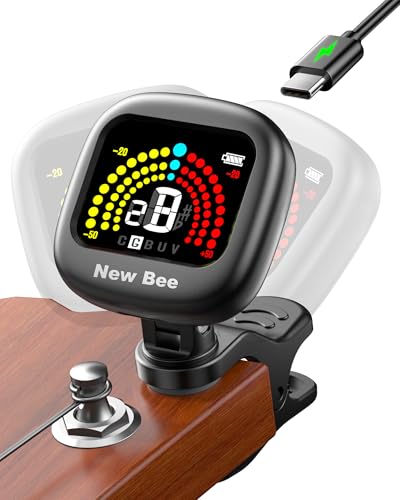
- ✓ Bright, high-res color screen
- ✓ Fast response and accuracy
- ✓ Rechargeable long battery
- ✕ Slightly bulky clip design
- ✕ Limited to 6-hour runtime
| Display | High-resolution color screen with 360° rotation |
| Sensor | High-sensitivity piezo sensor |
| Response Time | Pro-level speed with rapid response |
| Battery | Rechargeable with 6 hours of continuous use per charge |
| Connectivity | USB charging via supplied cable |
| Compatibility | Tunes guitar, bass, violin, ukulele, and other stringed instruments |
Many folks assume that a budget guitar tuner can’t deliver the speed and accuracy needed for serious practice or gigs. That myth gets busted right away when you clip this little device onto your guitar and see how swiftly it responds.
The instant you pluck a string, the display updates with a bright, clear readout.
The high-resolution color screen truly shines—literally. Whether you’re on a sun-drenched stage or in a dim studio, you’ll see your tuning notes instantly.
It cuts through any lighting, making tuning less frustrating and more precise.
The design is super compact and lightweight, so it doesn’t add bulk or weight. The clip works smoothly on any headstock, thanks to the padded clamp and 360° swivel.
Whether you’re left-handed, right-handed, or playing on different instruments, it’s easy to adjust and keep in place.
The rechargeable battery lasts around 6 hours, which is plenty for a long practice session or gig. Plus, the USB charging is convenient—just plug it into your laptop or power bank.
I found it quick to charge and always ready when I needed it.
Using it with one hand is simple—clip, tune, and go. The response time is lightning-fast, and the piezo sensor picks up even subtle pitch changes.
It’s perfect for quick tuning between songs or during practice without fuss.
Overall, this tuner offers pro-level speed and precision at a budget-friendly price. It’s a small but mighty tool that makes tuning effortless and reliable, no matter where you are.
What Are the Key Features of the Best Linux Guitar Tuners?
The key features of the best Linux guitar tuners include:
- User-Friendly Interface: A simple and intuitive user interface makes it easy for musicians of all skill levels to navigate the software and access tuning features without unnecessary complexity.
- Accurate Pitch Detection: High precision in pitch detection ensures that the tuner can accurately identify the notes being played, allowing for precise tuning of the instrument.
- Support for Various Instruments: The best tuners can accommodate a range of stringed instruments beyond just guitars, including basses, ukuleles, and mandolins, making them versatile tools for musicians.
- Multiple Tuning Modes: These tuners often offer several tuning modes (such as standard, drop D, open tunings) to cater to different playing styles and preferences.
- Visual Feedback: Graphics, such as needle-style indicators or LED displays, provide visual feedback on pitch accuracy, helping users to quickly see how close they are to being in tune.
- Custom Tuning Options: Users can often create and save custom tuning settings, allowing for personalized configurations that suit specific songs or styles.
- Integration with DAWs: Compatibility with digital audio workstations (DAWs) enhances a musician’s workflow, allowing them to tune their instruments within their recording setup seamlessly.
- Lightweight and Fast: The best tuners are designed to run efficiently on Linux systems, ensuring they consume minimal resources and provide quick responses during use.
- Open Source Availability: Many top Linux guitar tuners are open-source, allowing users to modify the software and contribute to its development, fostering a community-driven approach to improvements.
How Do You Choose the Right Guitar Tuner for Linux?
When selecting the best guitar tuner for Linux, consider the following options:
- Guitarix: Guitarix is a versatile guitar amplifier and effects processor that includes a built-in tuner. It offers real-time tuning with a clear visual display, making it easy to see whether your strings are in tune or need adjustment.
- Qtractor: Qtractor is a digital audio workstation that supports MIDI and audio, featuring a powerful tuner plugin. This makes it suitable for musicians who are looking for a comprehensive tool for recording and tuning their guitars within the same software environment.
- Guitar Tuner by Tuxguitar: Tuxguitar is a multi-track guitar tablature editor that comes with a simple yet effective guitar tuner. This application is particularly user-friendly for beginners and allows for tuning while also providing the ability to edit and create tablature.
- tuner: This is a lightweight command-line tuner that runs smoothly on Linux systems. It utilizes your microphone to analyze the sound of your guitar, giving you pitch detection in a no-frills interface that is perfect for users who prefer terminal applications.
- Guitartuner: Guitartuner is an easy-to-use graphical application that can help you tune your guitar accurately. It allows users to select different tunings beyond standard EADGBE, catering to various playing styles and song requirements.
What Free and Open Source Linux Guitar Tuners Are Available?
Several free and open-source guitar tuners are available for Linux, catering to different user preferences and features.
- Guitarix: Guitarix is a powerful virtual guitar amplifier that comes with a built-in tuner. It offers a graphical interface and is designed for low latency, making it ideal for live performances and practice. The tuner provides a visual representation of the pitch, helping musicians accurately tune their instruments.
- Qtractor: Qtractor is a digital audio workstation that includes a basic tuner plugin among its features. It allows users to edit and record audio while also providing the capability to tune instruments. This makes it a versatile tool for musicians who want both recording and tuning functionalities in one application.
- Guitar Tuner: Guitar Tuner is a standalone application that focuses solely on tuning instruments. It uses your computer’s microphone to detect pitches and offers a simple interface for users to quickly tune their guitars. This application is lightweight and easy to use, making it a great option for beginners.
- Tuner: Tuner is a simple command-line tool for Linux that utilizes the terminal for tuning guitars and other string instruments. It is perfect for users who prefer minimalistic software and want to quickly access tuning functions without graphical elements. The text-based interface also makes it lightweight and efficient for resource-constrained systems.
- AP Guitar Tuner: AP Guitar Tuner is a versatile application that can tune various string instruments and includes a visual pitch detection feature. With support for multiple tuning modes, it allows musicians to customize their tuning experience. This tool is particularly useful for those who play different types of string instruments beyond just the guitar.
How Accurate Are Different Linux Guitar Tuners?
Various Linux guitar tuners offer differing levels of accuracy and features suited for different users.
- Guitarix: Guitarix is a powerful audio system that includes a tuner as one of its many plugins. It offers precise tuning capabilities with a visual representation of pitch, making it easy for users to see how close they are to the desired note.
- QtOctave: QtOctave is a simple yet effective tuner that operates using a graphical interface. It provides accurate tuning by analyzing sound frequencies and is particularly user-friendly for beginners, allowing for quick adjustments and visual feedback on pitch accuracy.
- APT (Advanced Pitch Tuner): APT is designed for musicians who require high precision and supports various tuning systems. It includes features like customizable reference tones and a wide range of tuning presets, making it suitable for both standard and alternative tunings.
- Guitar Tuner by Fritte: This lightweight tuner is straightforward and focuses on accuracy without any additional features that may distract users. It is particularly useful for quick tuning sessions and is known for its reliable performance, ensuring that guitars are accurately tuned before performances.
- Stroboscopic Tuner: This tuner simulates a strobe light effect to provide extremely precise tuning. It is favored by professional musicians due to its accuracy in detecting pitch discrepancies, making it an excellent choice for those seeking the best possible tuning performance.
How Do You Install and Use a Linux Guitar Tuner?
To install and use a Linux guitar tuner, you can choose from several excellent applications that cater to different needs.
- Guitarix: Guitarix is a powerful virtual guitar amplifier for Linux that includes a tuner among its features.
- GNOME Tuner: GNOME Tuner is a simple and straightforward tuning application designed for GNOME desktop environments.
- Qt Tuner: Qt Tuner offers a graphical interface and is easy to navigate, making it suitable for both beginners and experienced users.
- AP Guitar Tuner: AP Guitar Tuner is a lightweight and efficient tool that works well across various Linux distributions.
Guitarix: Guitarix is primarily known as a virtual guitar amplifier, but it also comes equipped with a built-in tuner. To install it, you can typically use your package manager by running a command like `sudo apt install guitarix`. Once installed, you can access the tuner from the main interface, where it will display the pitch of the strings, helping you to accurately tune your guitar.
GNOME Tuner: GNOME Tuner is designed to integrate seamlessly into the GNOME desktop environment, making it user-friendly and visually appealing. Installation can be performed using `sudo apt install gnome-tuner`. After launching the application, you simply pluck a string, and the tuner will indicate whether the note is sharp, flat, or in tune, allowing for precise adjustments.
Qt Tuner: Qt Tuner leverages the Qt framework to provide an intuitive user interface that is easy to navigate. To install it, you can use the command `sudo apt install qt-tuner`. This tuner is particularly useful for beginners, as it offers visual feedback and adjustable reference frequencies, making it adaptable to various tuning standards.
AP Guitar Tuner: AP Guitar Tuner is known for its simplicity and efficiency, making it a great choice for quick tuning sessions. You can install it using `sudo apt install ap-guitar-tuner`. The tuner listens to the sound of your guitar and displays the corresponding note, enabling you to quickly identify if your strings are in tune or need adjustment.
What Are User Experiences with Popular Linux Guitar Tuners?
Users often explore various Linux guitar tuners for their functionality and ease of use.
- Guitarix: Guitarix is a powerful virtual guitar amplifier and effects processor that includes a built-in tuner. Users appreciate its intuitive interface and the ability to customize their sound while tuning, making it a versatile tool for both beginners and experienced guitarists.
- LinuxSampler: Although primarily a sampler, LinuxSampler can be paired with tuning plugins to help with guitar tuning. Users find it appealing due to its high-quality sound engine and compatibility with various MIDI devices, allowing for precise tuning adjustments.
- Qtractor: Qtractor is a digital audio workstation that supports a variety of plugins, including guitar tuning tools. Users enjoy its straightforward workflow and multi-track capabilities, enabling them to tune their guitars while simultaneously recording or editing tracks.
- Guitar Tuner by Aurelien Puyol: This standalone application is designed specifically for guitar tuning and is praised for its simplicity and effectiveness. Users find it easy to use with a clear interface that provides accurate pitch detection, making it suitable for quick tuning sessions.
- Audacity: While primarily an audio editing software, Audacity can be utilized for tuning guitars by analyzing audio frequency. Users appreciate its robust features and the ability to visualize tuning, which allows for precise adjustments when tuning their instruments.
How Do Linux Guitar Tuners Compare with Tuners on Other Operating Systems?
| Operating System | Features | User Experience |
|---|---|---|
| Linux | Open-source, customizable, supports various plugins (e.g., Guitarix, TuxGuitar) | User-friendly for tech-savvy individuals, community support available, often praised for accuracy and low latency |
| Windows | Commercial software availability, broader compatibility with hardware (e.g., Guitar Pro, Ultimate Guitar) | Intuitive interface for general users, less control for advanced users, offers mobile app integration |
| macOS | Sleek design, high-quality audio processing tools (e.g., GarageBand, AmpliTube) | Seamless integration with Apple devices, stable performance, includes mobile app options |