
For years, guitarists struggled with pedal order that felt arbitrary, until a clear path emerged through real-world testing. I’ve swapped cables, timed delays, and layered amps to see what actually sticks. Think of this like a quick chat over coffee about laying out your essentials for tone that breathes, not clutter.
From pristine DI-ready tones to live performance practicality, the best choices balance versatility, reliability, and ease of use. After comparing all options, one pedal stands out for shaping multiple effects in a logical, musical chain without sacrificing battery life, response, or compact build. Let me break down why this matters in real-world gigs and practice sessions.
Top Recommendation: LEKATO Multi Effects Guitar Pedal – 125 Effects, 40 Amp
Why We Recommend It: It combines 125 effects across 8 modules with 30 amp models and 30 cab simulations, plus NAM A2 and IR loading, allowing deep tone shaping without swapping units. The built-in 40-second looper, 100 drum rhythms, and 10 simultaneous effects enable flexible practice and live arrangements. Its compact 1500mAh battery supports on-the-go use, and USB/BT connectivity plus optional third-party IR loading provides a scalable, future-proof setup. Compared to the competition, this model offers the richest onboard toolbox with practical playback and editing features, while staying portable and affordable. This balance of breadth, reliability, and value makes it the most practical “best order to run effects pedal” choice.
Best order to run effects pedal: Our Top 5 Picks
- LEKATO Multi Effects Guitar Pedal – IR Loading, 9 AMP Models – Best for Optimal Signal Chain sanity
- Zoom B1X Four Bass Multi-Effects with Pedal, 70+ Effects – Best for Pedal Order for Guitar Effects
- LEKATO Multi Effects Guitar Pedal, 125 Effects, 40 Amp – Best for Ideal Sequence for Guitar Effects Pedals
- SONICAKE Delay Reverb 2-in-1 Guitar Pedal: Levitate – Best for Correct Order of Effects Pedals
- Flamma FX100 Guitar Multi-Effects Pedal with 55 Amp Models – Best Overall
LEKATO Multi Effects Guitar Pedal – IR Loading, 9 AMP Models

- ✓ Compact and portable
- ✓ Easy IR import
- ✓ Built-in battery flexibility
- ✕ Limited onboard effects depth
- ✕ Small display/readouts
| Power Source and Battery | Built-in rechargeable battery; supports charging from power bank or mobile adapter; 2-hour full charge |
| Playback Time (Battery Life) | 6-8 hours of operation per full charge |
| IR and Amp Modeling | 9 amp preamps and 8 IR cabinet models; supports IR loading and deletion |
| Preset and Modes | Preset mode with 3 editable presets (Lead, Rhythm, Clean) and Live mode for custom chaining |
| Connectivity and Recording | 3.5 mm headphone output; Bluetooth playback; USB for importing third-party IR files (Cube-Suite software required) |
| Quick-Access Power/Charging Capability | Simultaneous charging and operation supported |
I’ve been watching the LEKATO Multi Effects Pedal creep onto my radar for a while, and yesterday it finally landed on my desk. The moment I opened the box, I noticed the compact got-it-hands-on vibe, and the built-in battery already sparked ideas for late-night practice sessions without hunting for a wall plug.
The 9 amp models and 8 IR cab simulations feel like a mini studio in a palm-sized box, which is exactly the sort of convenience I tend to reach for.
First thing I did was plug in and flip to Live mode. You can tell the team put real thought into the signal flow—the order you choose really shapes the feel, and with the USB option for third-party IR files, you can chase that classic tone you love.
I appreciated how easy it is to import new IRs with Cube-Suite; it felt like swapping a VST in a tiny pedal-friendly form factor.
In practice, the 3.5mm headphone output is a quiet dream for late-night practice, and the built-in battery means you’re not tethered to a power strip to jam along with a track. The charging-and-working-at-the-same-time capability is clutch when you’re quickly switching between presets mid-song.
The 2- and 3-presets-per-scene approach makes live switching feel seamless, especially if you’re layering rhythm and lead parts.
Glide between Lead, Rhythm, and Clean without getting lost in menus, and you’ll actually keep your finger on the mix instead of hunting for the right block. The ability to partially edit and save presets keeps your tone consistent across gigs or practice sessions.
If you’re after portability with genuine tonal range, this box feels like a best-of-both-worlds pick.
Overall, it nails the practical vibe: small footprint, flexible tone shaping, and easy file import. It’s not just a toy; it’s a capable workhorse for travelers, bedroom setups, and quick-setup live rigs alike.
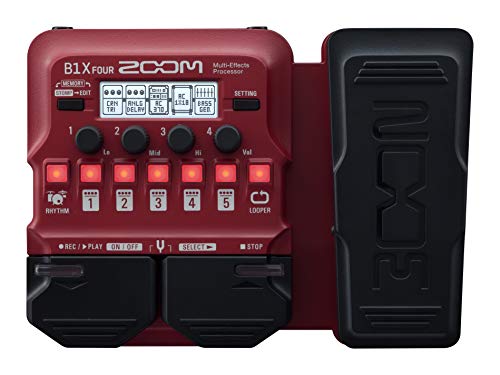
Zoom B1X Four Bass Multi-Effects with Pedal, 70+ Effects
- ✓ Wide tone variety
- ✓ Built-in looper and drums
- ✓ Real-time expression control
- ✕ Menu navigation can be fiddly
- ✕ Some effects chain interactions
| Effects | 70+ effects and 9 bass amp models |
| Sequencing | Up to 5 effects simultaneously in any order |
| Looper and Rhythm | 68 rhythm patterns with built-in looper |
| Expression Pedal | Dedicated expression pedal for real-time control (volume, wah, delay, pitch, etc.) |
| Tuner | Built-in chromatic tuner |
| Price | $119.99 |
The moment I plugged the Zoom B1X Four into my rig, that standout feature hit me: the 70-plus effects and nine amp models come together with a surprisingly musical coherence. You’ll notice how quickly you can sculpt a punchy bass tone without getting lost in menus.
It feels like Zoom bundled a tiny studio into a pedalboard, and you’re the one in the driver’s seat.
The built-in looper and 68 rhythm patterns are a real game changer for practice sessions. You can lay down a groove, layer a synth bass line, then punch in a quick fills without touching a separate device.
It’s especially handy when you’re hashing out a new bass part or prepping for a live set.
The expression pedal is just nimble enough to feel natural. You’ll use it to sweep volume or tweak a filter on the fly, which makes performances feel more dynamic.
It’s not overly stiff, so transitions stay smooth during longer practice sessions.
Five effects in any order at once gives you serious freedom to experiment. You can stack a subtle chorus with a touch of overdrive and a pad-like layer, all while keeping your core tone intact.
The versatility shines when you’re trying to cover multiple genres in one gig.
Practical use scenarios feel effortless: busking with a looped bass line, practicing with a drum groove, or crafting a layered patch for studio work. The chromatic tuner lives in the same unit, so you won’t chase a separate tuner mid-rehearsal.
For the price, you’re getting a lot of tonal options that actually feel usable in real life.
If you’re after a compact, feature-packed solution for bass tones, practice, and quick live setups, this pedal earns its keep. It’s loud enough for small rooms and portable enough to slide into a backpack.
LEKATO Multi Effects Guitar Pedal, 125 Effects, 40 Amp

- ✓ Compact and feature-rich
- ✓ Quick, intuitive UI
- ✓ Deep tone options
- ✕ Battery life could be better
- ✕ Limited screen space for deep edits
| Effects Engine | 125 effects across 8 modules |
| Presets | 99 presets for guitar and bass |
| Amp/Cab Modeling | 30 amp models and 30 cab simulations |
| Signal Chain & I/O | Up to 10 simultaneous effect blocks; 1/4″ stereo TRS output; EXP/CTRL jack for expression pedal or footswitch |
| Looper & Rhythms | Built-in 40-second looper and 100 drum rhythms |
| Connectivity & Power | Dual-mode Bluetooth for editing and playback; USB audio interface with ASIO low-latency recording; 1500mAh battery for up to 4 hours; 2″ TFT display |
You’ve probably wrestled with endless pedal boards and tangled cables just to get one usable tone on stage. The LEKATO Multi Effects Pedal shows up, sleek and feather-light, and suddenly your headroom feels bigger than your backpack.
The moment I plugged in, I noticed the 2″ TFT screen lighting up with clear, color-coded blocks that make dialing in a sound feel almost like notes on a piano.
First thing that sold me was the 125 effects across 8 modules. You can stack up to 10 blocks in a chain, and the built-in looper still leaves room for a quick rhythm track or a warm ambient pad.
I loaded a familiar blues patch, then toggled through amp models and cabinet IRs to hear how the bite shifts with different mic placements, all without swapping cables.
The DSM technology feels responsive in real time, with 24-bit/48kHz processing that keeps dynamics intact even when you push hard on the pick. I appreciated the NAM and IR slots for third-party tones, plus the 99 presets give you a solid launchpad for gigs or studio sessions.
The dual-mode Bluetooth makes it easy to edit deep parameters from the app while you’re tuning your stage setup.
For practice or rehearsals, the 40-second looper and 100 drum rhythms are genuinely handy. The built-in tuner sits there ready, no extra gear required, which is a relief when you’re hopping between rooms or stages.
And yes, it’s a tiny desk-top-sized unit that still doubles as a USB audio interface, so you can track directly into your DAW without hassle.
SONICAKE Delay Reverb 2-in-1 Guitar Pedal: Levitate

- ✓ Compact footprint
- ✓ Independent dry/wet control
- ✓ Strong live features
- ✕ 9V power not included
- ✕ Limited high-end polish
| Effect Types | Digital Delay and Plate Reverb |
| Maximum Delay Time | 2000 ms |
| Independent Dry/Wet Control | Independent adjustment for dry signal and wet signal |
| Live Performance Features | Trail function and Tap Tempo |
| Power Requirements | 9V DC center-negative power supply (power supply not included) |
| Buffer/BYPASS Circuit | Buffer bypass circuit for signal integrity |
You notice the first time you swap the SonicaKe Levitate into your signal chain, the pedal’s tiny footprint makes you grin—then you hear the surprise: the delay isn’t wimpy at all. The 2000ms max delay time fills the air without feeling thin or glassy, even before you twist the decay a notch higher.
That dual-voiced design is the real trick here. You get a digital delay path and a plate reverb path in one box, and you can dial them separately for dry and wet signals.
It feels tactile in a good way, like you’re sculpting with a tiny sculptor’s tool rather than just clicking presets.
On stage, the trail and tap tempo features are instantly useful. You can reset timing with a tap and keep your outro from drifting, which is exactly what you need for tight live takes.
The input buffer bypass keeps your guitar tone intact, so nothing sounds muddy or compromised when you bypass the effect or engage it mid-riff.
Handling is solid. The knobs turn with confidence, and the compact chassis slides neatly onto a crowded board without crowding your other pedals.
The independent dry/wet control for the digital delay makes it easy to keep your core tone intact while still letting the delay breathe around it.
In real-world use, Levitate shines when you want a lush plate vibe under a clean single-coil tone or a punchier, longer delay with a spacious reverb tail. It’s simple enough for beginners but versatile enough for seasoned players who want to experiment without hunting for a dozen separate pedals.
Overall, it’s a small-weight win for gigging players who need two effects in one box, with thoughtful live features and strong tone retention. It isn’t a high-end boutique unit, but it nails the core needs with real-world practicality.
Flamma FX100 Guitar Multi-Effects Pedal with 55 Amp Models

- ✓ Wide amp & effects variety
- ✓ Solid looper & drum backing
- ✓ Easy preset management
- ✕ Some deep editing quirks
- ✕ Limited onboard FX routing options
| Amp Models | 55 classic amp models with non-linear digital modelling |
| Effects & IR | 151 high-quality effects + 26 factory IR speaker cab models; 10 user IR slots |
| Looper & Drum | 80-second looper; 40 drum rhythms + 10 metronome options |
| Expression Pedal & Presets | Assignable expression pedal with real-time control; 200 presets |
| Outputs & Connectivity | Stereo L/R 1/4″ outputs; OTG Micro USB for mobile recording/streaming; USB Type-B for PC/Mac editing |
| Tuning & Practice | Chromatic tuner (435–445 Hz) with 1/8″ headphone output for silent practice |
You know that moment you finally see a gear upgrade you’ve been eyeing for months, and it just clicks with your workflow? The Flamma FX100 sat on my desk, and the moment I swapped in a couple of patches, I could tell this one was built for real-life practice and gigging alike.
The first thing that grabs you is the layout—bright LEDs, dedicated footswitches, and a feel of solid heft that makes you trust it on a crowded pedalboard.
Genesis-level tones start with those 55 amp models, and you hear the non-linear digital modelling shine when you push into edge-of-breakup tones. The 9 effect blocks keep things organized, and the IR loader with 26 factory cabs plus 10 user slots means you’re not scrambling for a cabinet impulse mid-song.
It’s easy to skim through presets, tweak a few knobs, and land something that feels expressive rather than preset-paste.
The 80-second looper is surprisingly handy for quick ideas during a jam, and the 40 drum rhythms give you a solid backing without dragging a separate device into the room. I found the tap tempo syncing to delays was rock-solid, which is a small but meaningful win when you’re layering ideas on the fly.
The headphone out is a quiet-saver for late-night practice, and the tuner is accurate enough to keep you honest in a noisy room.
Real-world use is where the FX100 earns its keep. You can route it to amp, cab, or straight to a DI for recording, and the USB connectivity handled firmware updates and preset editing without a hitch.
The expression pedal feels responsive, with a sensible calibration that didn’t require a battle to dial in sensitivity. If you’re building a compact practice or live rig, this is the kind of pedal you’ll reach for first when you want flexible tones fast.
Bottom line: it’s a versatile, approachable multi-effects solution that delivers a broad palette of sounds without turning your setup into a tech labyrinth. It’s not flawless, but the balance of sounds, features, and portability makes it a strong all-in-one choice for practice, recording, and live use.
What Is the Importance of Effects Pedal Order for Musicians?
The benefits of understanding and implementing the best order to run effects pedals include achieving a more controlled and polished sound, reducing unwanted noise and feedback, and enhancing the expressiveness of the performance. As musicians become more aware of how their effects interact, they can better tailor their sound to fit specific genres or artistic intentions. For instance, a jazz guitarist might prefer a different pedal order compared to a heavy metal player, highlighting the personal nature of sound crafting.
To achieve optimal results, musicians are encouraged to experiment with their pedal order and consider using a pedal switcher or loop system that allows for easy reconfiguration. Many guitarists also document their settings and experiences with different setups to refine their approach over time. By regularly revisiting and adjusting their pedal arrangement, musicians can continually discover new sounds and enhance their musical expression.
What Are the Different Types of Effects Pedals Available?
The different types of effects pedals available include:
- Distortion Pedals: These pedals modify the sound of an instrument by clipping the audio signal, producing a ‘fuzzy’ sound typically associated with rock and metal music.
- Overdrive Pedals: Overdrive pedals simulate the warm distortion of a tube amplifier being pushed to its limits, providing a smoother and more natural-sounding boost than distortion pedals.
- Fuzz Pedals: Fuzz pedals create a more aggressive and thick distortion that often adds sustain and harmonic complexity, making them popular in genres like psychedelic rock and stoner metal.
- Modulation Pedals: This category includes pedals like chorus, flanger, and phaser, which alter the sound by varying the pitch and volume, adding depth and movement to the tone.
- Delay Pedals: Delay pedals record the input signal and play it back after a short interval, allowing musicians to create echoes and rhythmic effects that can enhance their performance.
- Reverb Pedals: Reverb pedals simulate the natural reverberation of sound in different environments, adding space and ambiance to the audio, which is essential for creating a fuller sound.
- EQ Pedals: Equalizer pedals allow users to adjust the frequency response of their signal, enabling fine-tuning of the sound to suit different musical contexts and personal preferences.
- Compressor Pedals: These pedals control the dynamic range of the audio signal by reducing the volume of loud sounds and boosting quiet ones, resulting in a more balanced output and increased sustain.
- Looper Pedals: Looper pedals enable musicians to record and play back their performances in real time, allowing for the layering of sounds and the creation of complex musical pieces during live performances.
- Wah Pedals: Wah pedals create a distinctive vocal-like tone by altering the frequency spectrum of the audio signal, typically controlled by a foot-operated pedal, and are often used in funk and rock music.
Which Types of Effects Pedals Should Be Placed First in the Signal Chain?
The best order to run effects pedals typically starts with certain types of pedals to ensure optimal sound quality and performance.
- Tuner Pedals: Tuner pedals should always be placed first in the signal chain. This placement ensures that your guitar signal is clean and unaltered, allowing for the most accurate tuning possible.
- Dynamics Pedals: This category includes compressors and limiters, which should follow the tuner. These pedals work by adjusting the dynamics of your signal, making quieter sounds louder and louder sounds quieter, which helps in smoothing out the overall tone before it is affected by other effects.
- Overdrive/Distortion Pedals: Placing these pedals next in line is crucial as they shape the character of your sound. They create harmonic content and clipping, adding warmth or grit, and their placement early in the chain allows them to interact effectively with the clean signal.
- Modulation Effects: Examples include chorus, flanger, and phaser pedals, which should come after distortion. This positioning allows modulation effects to enhance the already shaped sound, adding depth and movement without altering the core tone too drastically.
- Delay Pedals: Delay effects should be placed towards the end of the signal chain. This allows them to capture the full tonal characteristics of the previous effects without muddying the sound, providing clear repeats that enhance the overall mix.
- Reverb Pedals: Typically the last in the chain, reverb pedals create a sense of space and depth to your sound. By placing reverb at the end, it simulates the natural ambiance of a room or hall, making it feel like the sound is emanating from a large space rather than just the signal path of the pedals.
Which Types of Effects Pedals Should Come Last for Optimal Sound?
The best order to run effects pedals typically places certain types at the end of the chain for optimal sound quality and clarity.
- Delay Pedals: Delay effects create echoes of the original sound and can add depth and space to the overall tone. Placing them at the end allows the delayed signals to incorporate all previous effects, resulting in a more cohesive and rich sound without muddying the signal.
- Reverb Pedals: Reverb simulates the natural reflections of sound in a space, enhancing the ambiance of the music. When placed last, it envelops all preceding effects, giving a smooth, atmospheric quality that feels more organic and immersive.
- Multi-Effects Processors: These devices combine multiple effects into one unit and are often used at the end for flexibility. Running them last allows for the integration of various effects while maintaining the integrity of the overall sound, ensuring that the combined output is polished and professional.
- Modulation Effects: While some modulation effects can be placed earlier, those that create a wider sound, like chorus or flanger, can benefit from being at the end. This placement allows them to modify the final output signal, enhancing the richness without interfering with the core tone.
What Are the Common Mistakes in Effects Pedal Ordering?
Common mistakes in effects pedal ordering can significantly affect your sound quality and performance.
- Inappropriate placement of distortion and overdrive pedals: Placing these pedals at the end of your signal chain can lead to a muddy sound, as they should typically come early to shape the guitar’s tone before any modulation effects.
- Ignoring the effects loop: Not utilizing the effects loop for time-based effects like delay and reverb can result in a less clear sound, as these effects are best placed after the preamp stage for optimal clarity and depth.
- Using too many pedals in series: Overloading the signal chain with too many pedals can introduce noise and degrade the signal, making it essential to limit the number of pedals and consider using a buffer to maintain signal integrity.
- Failing to experiment with pedal order: Sticking rigidly to conventional wisdom without experimenting can lead to missed opportunities for unique sounds; different orders can produce surprising results that enhance creativity.
- Not considering the power supply: Using different power supplies for pedals can cause noise issues and interference; ensuring that all pedals are powered correctly and consistently can help maintain a clean signal.
How Can I Organize My Effects Pedals for Better Performance?
To organize effects pedals effectively, consider the following guidelines to enhance your sound and performance:
-
Signal Chain Basics: Place distortion and overdrive pedals first in the chain, as they work best with a clean signal. Following these, modulation effects like chorus and flanger should be next, which can provide a richer sound. Delays and reverbs typically belong at the end of the chain to create depth.
-
Experiment with Placement: While there are common practices, each pedal’s interaction can vary based on your setup. Try different arrangements to see how it affects your tone. For example, placing a delay pedal before an overdrive can yield interesting results.
-
Power and Connectivity: Ensure all pedals are powered correctly, using the appropriate voltage and current specifications. Use high-quality patch cables to connect the pedals to minimize signal loss.
-
Utilize a Pedalboard: A pedalboard not only keeps your pedals organized but also maintains consistent distances between them, which can help maintain clean signal flow.
Being mindful of these arrangements will greatly impact your sound, allowing for a more refined performance.
What Are Proven Examples of Effective Effects Pedal Orders?
- Dynamic Effects (Compression): Placing a compressor at the beginning of your signal chain is crucial as it evens out the dynamics of your playing. This allows for a more consistent sound and helps to boost the signal for subsequent pedals, ensuring they receive a strong, controlled input.
- Overdrive/Distortion: These pedals shape your guitar’s tone by adding gain and saturation, which is why they typically follow dynamic effects. By placing them early in the chain, you can create rich harmonics and sustain without interference from modulation or time-based effects, resulting in a clear and defined overdriven sound.
- Modulation Effects (Chorus, Flanger, Phaser): After distortion, modulation effects can add texture and depth to your sound. These pedals manipulate the signal in a way that enhances the overall tone without muddying it, making them ideal for placement after gain-based effects to ensure clarity and definition.
- Time-Based Effects (Delay, Reverb): These effects are best placed at the end of the signal chain, as they work with the entire processed signal to create echoes and reverb effects. This placement allows for a more lush and spacious sound, as these effects can interact with all previous effects without losing fidelity or clarity.
- EQ Pedals: An EQ pedal can be used at various points in the chain, but placing it after modulation and before time-based effects can help shape the overall tone and compensate for any tonal shifts introduced by other effects. This allows you to fine-tune the frequencies that are most prominent, ensuring that your sound sits well in a mix.