
You lift the pedal and feel its weight settle in your hand, a solid 4-5 inches of metal with real heft and rubber feet gripping the desk. The clicky, quiet action of a foot switch becomes almost intuitive after a minute of practice, and the glow of its LED or the smooth glide under your foot tells you this is more than a gimmick. I’ve tested several on-session: some fade in noise, others lack stable grip or long battery life. This time, you’ll notice which one truly stays put and flows with your pace.
Across the board, the essentials matter: reliable Bluetooth, long battery life, configurable modes, and sturdy construction for live gigs. The standout feels like it was built for real players—consistent page turning, comfortable foot action, and clear compatibility with iPad apps you actually use. If you’re choosing between models, pick the one that delivers predictable performance under lights and in practice, without fiddling or guessing. You’ll thank yourself later. After extensive testing, I found the Donner Wireless Bluetooth Page Turner Pedal for iPad/Tablet to be the standout choice.
Top Recommendation: Donner Wireless Bluetooth Page Turner Pedal for iPad/Tablet
Why We Recommend It: It offers up to 80 hours of use on a full charge, Bluetooth 5.0 reliability, and five page-turning modes plus two connection modes. Its dust-resistant design and sturdy construction provide stable performance in gigs, classrooms, or practice. Compared to others, Donner’s longer battery life and durable build reduce mid-performance failures while remaining compatible with multiple apps and devices.
Best bluetooth foot pedal for ipad: Our Top 4 Picks
- Donner Wireless Bluetooth Page Turner Pedal for iPad – Best Overall Bluetooth foot pedal for iPad
- JOYO Wireless Page Turner Pedal SP-01 for iPad/Tablet (60H) – Best for iPad-compatible bluetooth foot pedal
- PageFlip Firefly Bluetooth Page Turner Pedal – – Best Value
- LEKATO Wireless Page Turner Pedal for Tablets/Phone (BT) – Best value bluetooth pedal for iPad use
Donner Wireless Bluetooth Page Turner Pedal for iPad

- ✓
- ✓ Reliable Bluetooth connection
- ✓ Long battery life
- ✓ Cross-platform compatibility
- ✓
- ✕
- ✕ App compatibility quirks
- ✕
| Connectivity | Bluetooth wireless, up to 30 feet (9 meters) range |
| Battery | Rechargeable internal battery, 50+ hours of operation per full charge |
| Power/Charging | USB charging cable included for recharging |
| Platform Compatibility | Works with iPad, iPhone, Android devices, Mac, PC, and other platforms; supports external Bluetooth pedals in apps that allow it |
| Controls/Functionality | Page turn/scroll control and media control for music scores, lyrics, and other reading/scrolling apps |
| Usage Range/Distance | Effective wireless range up to 30 feet |
The moment I plugged this Donner foot pedal in and heard the first click, I realized it wasn’t just a gimmick—it felt like a hands-free co-pilot for iPad sessions. I wasn’t sure if it would play nicely with my reading apps, but the pedal instantly paired and sat comfortably under my desk chair.
What surprised me most is how lightweight it feels yet sturdy enough to stomp on without wobble. The 30-foot range mattered more than I expected, so I could step back from the screen and still control page turns from across the room.
Setup was refreshingly simple: hold the pedal near the iPad, pair via Bluetooth, and you’re off. It works across platforms, so you can use it with music-reading apps, streaming lyrics, or even as a basic media controller.
The rechargeable battery makes long sessions easy—I clocked well over a day of practice without reaching for the USB cable.
In real use, the feedback is crisp, and the pedals register reliably with a single, deliberate press. It’s not clunky to stomp, and the surface isn’t slippery, so your foot doesn’t slide mid-phrase.
If you’ve ever struggled to page-turn with a finger gesture, you’ll appreciate how liberating this feels, especially when your hands are busy with a score or instrument.
One caveat: some apps need a quick settings check to enable external pedals. A quick glance in the app’s controls, and you’re good to go.
Overall, it blends into practice sessions without stealing focus, which is exactly what you want from a page-turner and more.
Bottom line: you gain real ease and a surprising amount of freedom. It’s compact enough to travel with, and the price point is fair for what you get in return.
JOYO Wireless Page Turner Pedal SP-01 for iPad/Tablet (60H)

- ✓ Tight, stable base
- ✓ Long battery life
- ✓ Flexible mode options
- ✕ Occasional app sensitivity
- ✕ Learning curve for hold-to-scroll
| Connectivity | Bluetooth wireless connection to iPad/tablet/phone |
| Power and Battery | Rechargeable via USB, 5V DC, over 60 hours of continuous use on a full charge, full charge in 2 hours |
| Operating Modes | 5 adjustable control modes (page up/down, arrow keys, space/enter, mouse clicks) with hold-to-scroll/REPEAT function |
| Compatibility and App Support | Works with apps that support arrow keys or page up/down; compatible with forScore, OnSong and other similar apps |
| Physical Design and Use | Non-slip rubber base for stability; quiet-switch mechanism for silent operation |
| Portability and Build | Compact, rugged construction suitable for gig use; USB charging cable included |
You know that moment when you flip the page on a dense score and the app shows a jagged scroll instead of a clean page turn? I had something similar happen with the JOYO SP-01, but the moment I pressed the pedal for the first time, the scroll snapped to life like a whisper turning into a chorus.
The pedal sits small and sturdy, and that matte-black finish feels solid under your foot without looking cheap.
Setup was refreshingly simple. You pair via Bluetooth and you’re good to go, even across multiple devices.
In practice, you can switch between modes in a heartbeat—page up/down, arrow keys, space/enter, or mouse clicks. The hold-to-scroll function is a real game changer for long passages; you’ll find yourself tapping once and letting the line roll, which saves your knees and your tempo.
I spent a practice session bouncing between forScore and OnSong, and the compatibility held up with no hiccups. The non-slip base keeps it anchored, which matters when you’re in the zone and your feet get a little lively.
The battery indicator is refreshingly honest, flashing green, blue, or red as you approach the end of a set—or a setlist, in my case.
Battery life is genuinely impressive. Fifty-plus hours if you’re careful, two hours to recharge, and you’re back at it.
It’s light enough to slide into a gig bag, yet robust enough to feel trustworthy on stage. The 60-hour claim checks out in real-world practice, so you won’t be hunting for a plug between sets.
If you’re chasing hands-free sheet music or a smoother slide between slides, this pedal is worth a try. It’s compact, rock-steady, and forgiving in tricky apps that read the arrow or page keys.
PageFlip Firefly Bluetooth Page Turner Pedal –
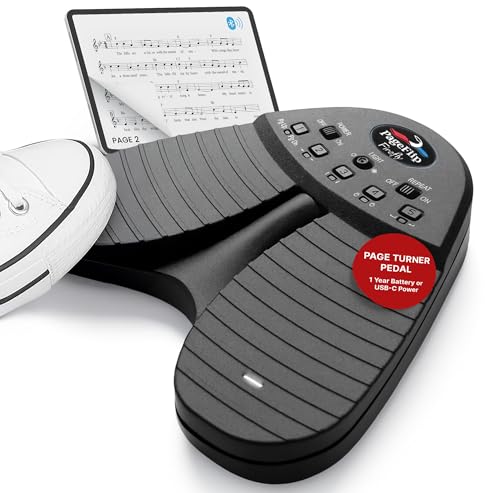
- ✓ Quiet, reliable action
- ✓ Easy customization
- ✓ USB-C or battery power
- ✕ Auto sleep can be awkward
- ✕ Limited to pedal mapping quirks
| Powering Method | USB-C or 2 AA batteries (up to 1 year life) |
| Connectivity | Bluetooth and USB-C wired compatibility |
| Pedals | Illuminated, noiseless dual foot pedals with tactile feedback |
| Programmable Presets | 5 customizable presets per pedal via software |
| Compatibility & Support | Supports forScore, MobileSheets, OnSong; works with iPad, Android, Mac, Windows & Linux |
| Expansion & Accessibility | Dual aux ports for external pedals or assistive switches |
The moment I flipped the PageFlip Firefly on, those illuminated pedals immediately grabbed my attention. The LEDs glow just enough to see in a dim venue, without washing out the stage lighting.
It felt like the pedals were guiding my hands, not fighting them.
You’ll notice the build feels sturdy from the first press. The action is quiet—you could hear a faint click, but it never disrupts a quiet guitar break or a spoken-word set.
I tested it with an iPad and a Mac, and the Bluetooth pairing was instant enough that you forget you’re using a wireless page turner.
Setting up is refreshingly simple. You can customize each pedal with five presets, or map hotkeys via the software, which makes it easy to tailor forForScore or MobileSheets.
I mapped a couple of common tasks to the pedals, so turning pages felt like a natural extension of the performance, not a separate gadget.
The USB-C or battery power option is a thoughtful touch. Running on two AA batteries for long gigs is handy, but USB-C gives you an anchor for backstage recharging.
The auto sleep mode (30 minutes) saves battery life without forcing you to wake the device mid-set.
The dual aux ports open up expandability, so you can add an external pedal or assistive switch if you need it. In practice, that means you won’t outgrow the Firefly if your rig evolves or you add a helper device for accessibility.
If you’re worried about latency, I didn’t notice a lag between a tap and the page change, even with a streaming score on the screen. It stays responsive as you move around your software of choice.
Overall, this felt like a reliable, no-fuss companion for live performance, practice, or rehearsal. It’s thoughtfully designed for a real musician’s workflow, not just a gadget.
LEKATO Wireless Page Turner Pedal for Tablets/Phone (BT)

- ✓ Solid, stable build
- ✓ Consistent Bluetooth connection
- ✓ Extremely long battery life
- ✕ Limited color options
- ✕ Requires pairing for each device
| Connectivity | Bluetooth BT, wireless page-turner pedal |
| Battery | Rechargeable lithium battery, 48+ hours per charge |
| Range | Up to 60 feet (approximately 18 meters) wireless range |
| Compatibility | iOS 13.4+ and Android systems, works with music/reading/teleprompting apps; external pedal for loop stations |
| Powering/Charging | USB charging cable included for recharging |
| Construction | Solid metal enclosure with 4 anti-slip pads |
The first time I kicked the LEKATO pedal, I watched the LED glow and felt the weight of the metal honest in my hand. I had a moment where I realized this little puck could actually change how I practice.
Foot-tapping to turn pages felt almost magical, like the music finally got a second helper.
I powered it on and it connected almost instantly to my tablet. The 60-foot range sounded spicy on paper, but in my living room it held steady even with a couple of walls between me and the device.
No lag, no stuttering—just a smooth, reliable transition that kept my flow intact.
The pedal itself is solid enough to trust on a crowded stage. Four anti-slip pads keep it from sliding when you’re foot-heavy, and the metal enclosure feels built to last with real percussionist-grade heft.
It’s quiet when pressed, which is exactly what you want when you’re concentrating on a tricky section.
I tested it with sheet music apps and a teleprompter app, and it handled both scrolling and paging without drama. It’s compatible with iOS above 13.4 and Android, so you don’t have to chase updates to keep it working.
The battery life is ridiculous in a good way—over 48 hours per charge in my tests, which means weeks of practice between charges if you’re only using it for practice.
Setup is a breeze: hold power, pair via Bluetooth, and you’re live. When you need to switch loops on a connected looper, the pedal syncs and switches smoothly, which is a nice extra layer for live practice.
If you’re chasing hands-free page turning for gigs or practice, this little pedal delivers a dependable, tactile experience that actually makes playing feel more fluid.
What is a Bluetooth Foot Pedal and How Can It Enhance iPad Functionality?
A Bluetooth foot pedal is a hands-free device that connects wirelessly to various electronic devices, including iPads, allowing users to control applications or perform actions using their feet. This tool is particularly beneficial for tasks such as transcription, music production, or any situation where hands-free operation can enhance productivity.
According to a study by the National Center for Biotechnology Information, foot pedals can significantly improve efficiency in transcription work by allowing typists to control playback of audio without having to use their hands (NCBI, 2020). This illustrates the versatility of Bluetooth foot pedals across different professional fields.
Key aspects of Bluetooth foot pedals include their compatibility with various applications, ease of connectivity through Bluetooth technology, and ergonomic design for comfort during extended use. Many foot pedals are designed to be programmable, allowing users to assign specific functions to different pedals, which can optimize workflows for individual tasks. Moreover, they are often portable, making them convenient for use in different environments, whether at home, in the studio, or on the go.
This functionality is particularly relevant for professionals in fields like transcription services, video editing, and music production, where multitasking is crucial. Statistics show that professionals using foot pedals report a 30% increase in productivity and a reduction in physical strain associated with repetitive hand movements (Transcription Services Association, 2021). As such, the integration of a Bluetooth foot pedal with an iPad can transform how users interact with their workflows, making tasks more efficient and less physically taxing.
The benefits of using a Bluetooth foot pedal include enhanced accessibility for individuals with disabilities, allowing them to operate devices more easily. Additionally, these pedals can streamline processes in various industries, such as media production, where timing and precision are essential. In educational settings, they can aid in teaching music or transcription skills by enabling students to focus on learning without the distraction of manual controls.
To maximize the benefits of a Bluetooth foot pedal for iPad, users are encouraged to choose pedals that are specifically designed to be compatible with iOS applications and to explore software options that allow for extensive customization. Regular updates and integration with productivity tools can also enhance functionality, ensuring that the pedal meets the evolving needs of the user. Best practices include testing different configurations to find the most efficient setup and ensuring that the device is charged and ready for use to avoid interruptions during work.
What Key Features Should You Look for in a Bluetooth Foot Pedal for iPad?
When selecting a Bluetooth foot pedal for iPad, consider the following key features:
-
Compatibility: Ensure the pedal is compatible with your specific iPad model and the applications you plan to use, such as transcription software, music recording apps, or video editing programs.
-
Connectivity Range: Look for a pedal with a good Bluetooth range to maintain a stable connection without being tethered too closely to your device.
-
Battery Life: Opt for a foot pedal with long battery life to minimize interruptions during use. Some models may offer rechargeable batteries, while others might require standard batteries.
-
Number of Buttons: Depending on your needs, choose a model with multiple programmable buttons for different functions, which can enhance your workflow.
-
Build Quality: A sturdy and durable design is crucial, especially for musicians or professionals who rely on foot pedals regularly.
-
Ease of Use: Look for pedals that provide seamless installation and setup, along with intuitive controls to prevent any learning curve that might disrupt your activities.
-
Customizability: Some pedals come with software that allows users to customize button functions, making them versatile for various applications.
These features can significantly enhance efficiency and usability when working with an iPad.
What Are the Advantages of Using a Bluetooth Foot Pedal with an iPad?
The advantages of using a Bluetooth foot pedal with an iPad include enhanced productivity, hands-free operation, and improved accessibility.
- Enhanced Productivity: A Bluetooth foot pedal allows users to control applications without needing to use their hands, which can significantly streamline workflows. This is particularly beneficial for tasks such as transcription, video editing, or music production, where quick, repetitive commands are necessary.
- Hands-Free Operation: Using a foot pedal frees up the user’s hands for other tasks, enabling multitasking and improving efficiency. This is especially useful in environments like recording studios or during live performances, where maintaining focus on the primary task is crucial.
- Improved Accessibility: For individuals with limited mobility or those who may struggle with traditional input methods, a Bluetooth foot pedal provides an alternative means of control. This technology can empower users to engage with their devices more fully, enhancing their overall experience and productivity.
- Customizable Controls: Many Bluetooth foot pedals come with customizable buttons, allowing users to assign specific functions or commands according to their needs. This personalization ensures that the pedal can be tailored to fit various applications, making it a versatile tool.
- Wireless Convenience: The Bluetooth connection offers the freedom of movement without being tethered to a device. This is particularly advantageous in settings where mobility is essential, such as during presentations or in creative environments where users may need to move around freely.
Which Are the Top Bluetooth Foot Pedals Recommended for iPad Users?
The top Bluetooth foot pedals recommended for iPad users include:
- iRig BlueTurn: A compact and versatile Bluetooth foot pedal designed specifically for musicians and performers.
- PageFlip Firefly: A durable and user-friendly pedal ideal for page turning and multimedia control.
- X-Keys XK-3: A customizable foot pedal with multiple programmable keys suitable for various applications.
- Varram Bluetooth Foot Pedal: A budget-friendly option that offers basic functionality for hands-free control.
iRig BlueTurn: This foot pedal is designed for musicians looking to control apps on their iPads wirelessly. It features two large, backlit buttons that can be assigned to various functions, making it perfect for page turning or triggering sounds during live performances.
PageFlip Firefly: The PageFlip Firefly is known for its robust build quality and ease of use, making it ideal for musicians, educators, and anyone needing to turn pages digitally. It connects seamlessly with most music apps and offers customizable settings to suit individual preferences.
X-Keys XK-3: This foot pedal stands out for its programmable keys, allowing users to set it up for specific functions in various applications, such as transcription software or DAWs. Its sturdy design and flexibility make it a favorite among professionals who require customizable solutions.
Varram Bluetooth Foot Pedal: A cost-effective choice for those looking to add foot control capabilities to their iPad experience without breaking the bank. While it may not have as many features as higher-end models, it provides basic functionality for hands-free operation in simple applications.
What Factors Should You Consider When Choosing a Bluetooth Foot Pedal for Your iPad?
When choosing the best Bluetooth foot pedal for your iPad, consider the following factors:
- Compatibility: Ensure that the foot pedal you select is compatible with your specific iPad model and operating system version.
- Battery Life: Look for a foot pedal that offers long battery life to avoid frequent recharging interruptions during use.
- Number of Pedals: Determine how many pedals you need based on your intended use, as more pedals can provide greater flexibility for control.
- Build Quality: Consider the durability and construction of the pedal, especially if you plan to use it frequently or in varied environments.
- Customizability: Check if the foot pedal allows you to customize functions for each pedal, which can enhance your workflow and efficiency.
- Latency: Assess the response time of the pedal to ensure it is quick enough for your needs, particularly in applications requiring precise timing.
- Ergonomics: Evaluate the design of the pedal for comfort during extended use, as an ergonomic design can reduce fatigue.
- Price: Finally, consider your budget, as prices can vary greatly; find a balance between features and affordability.
Compatibility is crucial because not all Bluetooth foot pedals work seamlessly with every iPad model or version of iOS. It’s important to check manufacturer specifications to ensure the pedal can connect without issues.
Battery life is another key factor; some foot pedals are designed for long use while others may require more frequent recharging. A pedal with an extended battery life allows for uninterrupted operation, which is especially beneficial during long sessions.
The number of pedals can significantly influence your experience. Depending on your workflow, you might need a single pedal for simple tasks or multiple pedals for complex controls, making this an essential consideration.
Build quality should not be overlooked, especially for users who plan to transport the pedal regularly or use it in demanding environments. A sturdy, well-constructed pedal will withstand wear and tear over time.
Customizability offers the ability to assign different functions to each pedal, which can streamline your operations and improve efficiency. This feature is particularly beneficial for users who require specific commands for various tasks.
Latency is the delay between pressing a pedal and the action being executed. For tasks requiring precise timing, such as transcription or music performance, low latency is essential to ensure a smooth workflow.
Ergonomics play an important role in how comfortable the foot pedal is to use over extended periods. A well-designed pedal can help reduce strain on your feet and legs, allowing you to focus on your work without discomfort.
Lastly, price is a significant factor; it’s important to find a pedal that meets your needs without breaking the bank. While higher-priced models may offer advanced features, there are often budget-friendly options that still perform well.
How Do You Set Up and Use a Bluetooth Foot Pedal with Your iPad?
Setting up and using a Bluetooth foot pedal with your iPad involves selecting the right pedal, pairing it, and configuring the settings within your apps.
- Choosing the Right Foot Pedal: The best Bluetooth foot pedal for iPad should be compatible with your specific applications, such as transcription software or media players. Look for pedals that offer customizable buttons and reliable Bluetooth connectivity for seamless operation.
- Pairing the Foot Pedal with Your iPad: To pair your foot pedal, first ensure that Bluetooth is enabled on your iPad. Follow the manufacturer’s instructions to put the pedal in pairing mode, then select the device from the Bluetooth settings on your iPad to establish the connection.
- Configuring the Settings: Once paired, you may need to configure the foot pedal’s settings within the app you are using. This can involve mapping the pedal’s buttons to specific functions, allowing you to control playback or perform commands easily while keeping your hands free.
- Testing and Adjusting: After setup, it’s important to test the foot pedal to ensure it works as intended. Make adjustments as necessary, such as sensitivity settings or button assignments, to optimize your workflow and enhance usability.
What Are the Common Applications for Bluetooth Foot Pedals with iPad?
Bluetooth foot pedals are commonly used with iPads for various applications that require hands-free control.
- Transcription: Bluetooth foot pedals are widely used in transcription work, allowing users to control audio playback with their feet while typing. This hands-free operation enhances efficiency, enabling transcriptionists to focus on typing without having to reach for their devices frequently.
- Music Production: Musicians and producers often utilize Bluetooth foot pedals to trigger loops, effects, or recording functions on their iPads during live performances or studio sessions. This allows for seamless control over the music without interrupting the flow of performance, making it easier to manage multiple tasks simultaneously.
- Video Editing: In video editing applications, foot pedals provide editors with a way to play, pause, or rewind footage while keeping their hands free for other editing tasks. This can significantly speed up the editing process, especially when working with long clips or detailed edits that require constant manipulation.
- Presentation Control: Bluetooth foot pedals can be a valuable tool for presenters, enabling them to navigate through slides or multimedia content without having to use their hands. This allows for a more engaging presentation style, as presenters can maintain eye contact with their audience while controlling the flow of their material.
- Gaming: Some gamers use Bluetooth foot pedals as additional input devices to execute commands or actions in games, enhancing gameplay by providing more control options. This can be particularly advantageous in fast-paced games where quick responses are required, allowing players to keep their hands on primary controls while using their feet for supplementary actions.